



How Figma sells to the users behind 95% of its pipeline
Outbound teardowns by October 2026
- Company
- Figma sells a browser-based design and collaboration platform, from a free plan to company-wide contracts. Visit Figma ↗
- Sales team
- First sales hire in July 2018, at about 40 to 45 employees
TL;DR
Figma’s first salespeople built their outbound list from product usage, with each company’s users grouped into one account and the people already inside named for the rep. The 95% is from February 2023 and shows where pipeline came from.
The lesson
Your best outbound list may already be in your product. Start with companies whose employees use you, open the call with that usage, then sell the value to the company.
For your team
Next to each ranked account, name its most active user and the person who invited the most colleagues, and flag anyone whose title suggests they sign.
What Figma did
The starting point
Figma had a self-serve product and no sales team.
Figma hired its first salesperson, Kyle Parrish, in July 2018. He has said its enterprise product was still in beta.1a When he left in January 2025 he wrote: “When I joined, we were a team of 45 Figmates and $2M in ARR.”2
It had grown on a self-serve paid plan called Professional. Its S-1 says: “Users started inviting their collaborators to join them in Figma, and as we began charging for Figma in 2017, this drove conversions from free to paid plans.” By February 2019 co-founder and CEO Dylan Field could point to “over a million signups.”3,4
Field’s first instruction to Parrish was to learn the users before selling to them. “Dylan, our CEO, suggested that I spend my first four weeks at Figma shadowing the support team,” Parrish wrote in 2021.5b
The problem
Figma could not see which users worked at the same company.
Census, the vendor that piped Figma’s product data into Salesforce, wrote in 2020 that inconsistent user, team and organization models made it “impossible for Account Executives to understand which prospects were using Figma inside the organization, and for what purposes.”6
Claire Butler, Figma’s first go-to-market hire, has said Figma spread at Microsoft from one small team, Xamarin, on credit cards, skipping procurement and security, until Microsoft asked Figma to organize it.7
Parrish knew one shortcut from five years at Dropbox and distrusted it: telling a CIO how many of their people already used the product. He has said that could poke the beehive, and some companies answered by blocking Dropbox.1
The decision
January 29, 2019
Figma launched its first enterprise plan and built its sales list from who already used the product.
That day Field announced Organization as “our first enterprise-grade offering,” built with beta customers.10 Behind it, Parrish and Praveer Melwani, then in finance and now CFO, were building a usage model Parrish calls the company’s big bet for its first three years of selling.1 By August 2020 Parrish said Figma was moving from inbound interest to outbound.11
The redesign
One ranked account per company, with the people already using Figma named inside.
Users became accounts
Parrish has said the team structured Salesforce around Figma’s product data, carried from its Redshift warehouse by a reverse ETL tool, which copies warehouse data into business apps.1,6,11
Accounts ranked on fit and product signal
Parrish has said the first ranking measure was the number of design editors in the platform, with Clearbit company data layered on top, and account executives got books of business built on usage.1
Not every signup went to a rep. Amanda Kleha, Figma’s chief customer officer, said in 2021 that “people who sign up for Figma, we don’t pass all of them to sales.” The handoff weighed the account’s size and profile, what the lead did in the product, and strategic accounts placed in reps’ books ahead of time.12
In 2023 Jesus Requena, who built Figma’s growth marketing team, described the ranking as two axes: “We split accounts into high/low fit (firmographics) and high/low product signal or intent. We want reps to prioritize based on best fit and highest signals and go down from there.”13c
Fit and product signal, worked from the top right
Names inside each account
Requena said the model also highlighted champions, the “top users based on actions,” and decision makers “based on titles or roles within the product.” Choosing among them was left to the rep: “The sales rep will decide who to reach out to, when, and with what message.”13
Katie Jane Bailey, a senior account executive by late 2021, named her own list: “I’m talking to the most active user, the admin on the paid team, the VP of Design (who is the actual decision-maker).”14
The call
A Figma cold call, in the rep’s own words
“So especially when a team’s using Figma already, the conversation usually goes something like this…”
- Bailey
Hey John, did you know that a lot of your team’s using Figma?
- John
No, I didn’t know that.
- Bailey
Cool. Should we talk about that?
- John
Yes. Let’s talk about that.
Parrish has said reps can tell people Figma knows they use it, then build the conversation around the value Figma provides. That stops short of the Dropbox-style pitch to a CIO about how many employees already use the product.1
By early 2023 each signal came with a message. Requena’s team and product marketing built “a message framework that, based on the data signal, would correlate with a pain point and a value prop message to leverage that signal.” Reps could use it “in a personalized way with their outreach.”13
Champions, then the top of the account
The person who carried a deal inside the company was usually a user. “A lot of my job is coaching champions,” Bailey wrote. At one slow-moving institution, coaching a single designer every week got Figma a look: “it just took one persistent voice to make it happen.”14
Those champions were often new to buying. Figma’s main initial buyer, the head of design, is “not buying software every day,” Kleha has said.12 Marissa Fuhrer, a Figma enterprise sales manager, told reps in 2022 to test whether a contact was a champion or only a coach with little influence by asking early for an introduction to the executive who signs, framed as protecting the champion’s reputation.15
Senior people often don’t use the product, so growth marketing reached decision makers with content and events and passed them to sales as marketing qualified leads. Requena called it “a bottoms-up meets top-down approach.”13
The result
Pipeline came from the people already using Figma.
- Feb 202395%of pipeline from users already active in Figma
- 2024~70%of new Organization and Enterprise customers included a former Professional user
- Jun 20261,635customers paying Figma over $100K a year, up from 1,031 in Mar 2025
The S-1 adds that about 70% of revenue in 2024 and early 2025 came from Organization and Enterprise customers.3d
In March 2026 chief revenue officer Shaunt Voskanian said Figma has no traditional SDRs or customer success team, and that most of its sales work is outbound into existing customers, with each rep building champions across a prioritized book of accounts.17
What it took
Figma spent about five years building toward the system Requena described, and the data came before the ranking.
Parrish has said he, Melwani and a handful of others built the reverse ETL pipeline early.1 Sean Whitney, who ran Figma’s ARR reporting, has said analysts modeled each funnel step with SQL, alongside growth, finance and business operations, treating teams as the unit Figma charged for.18 As the team grew, sales ops cut territories around large buckets of Professional usage, Melwani has said, and accounts grew from single domains to corporate parents.19 Figma’s Help Center now shows the same company model to customer admins.8
Figma’s admin console, in Figma’s own Help Center
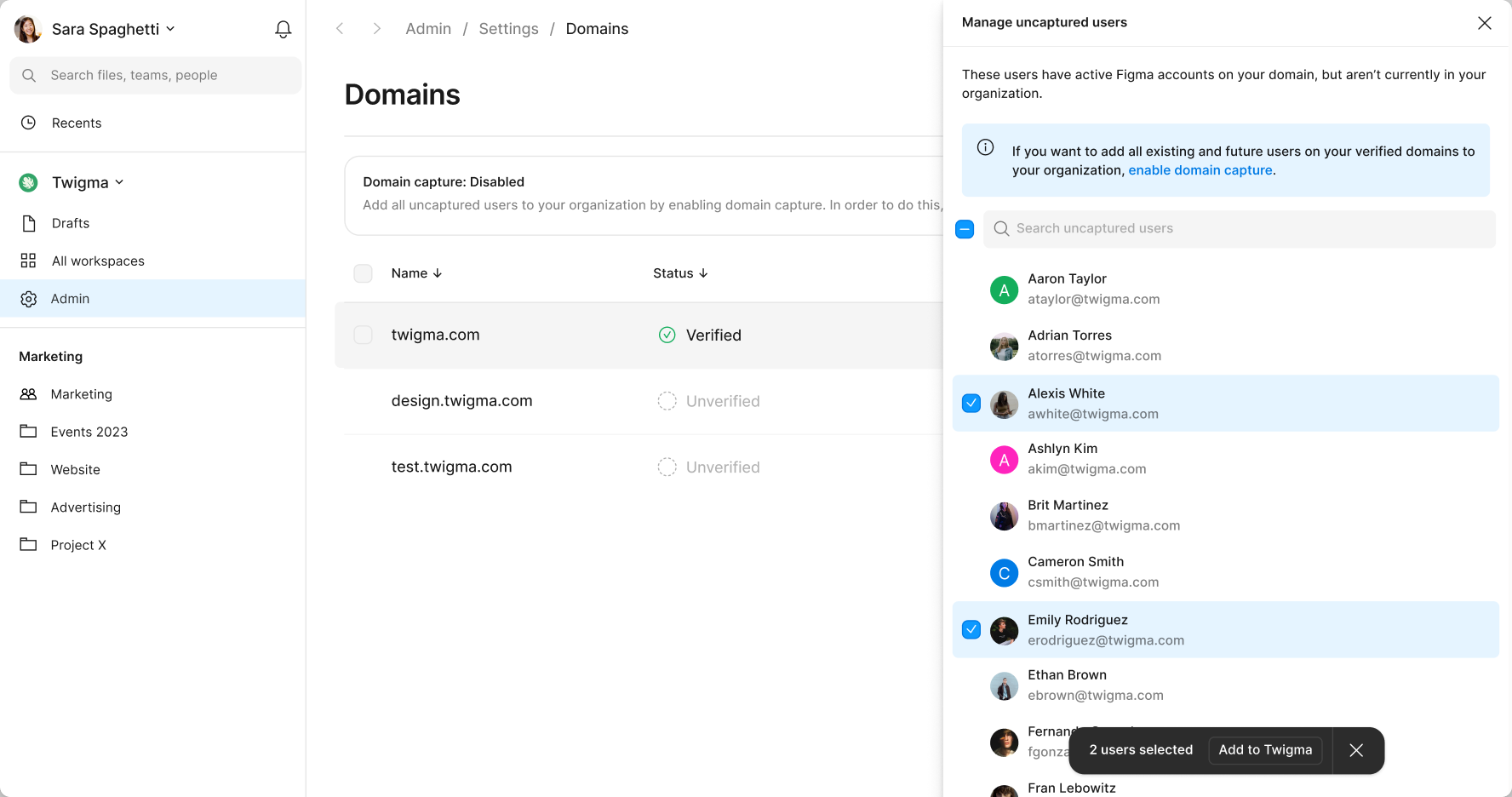
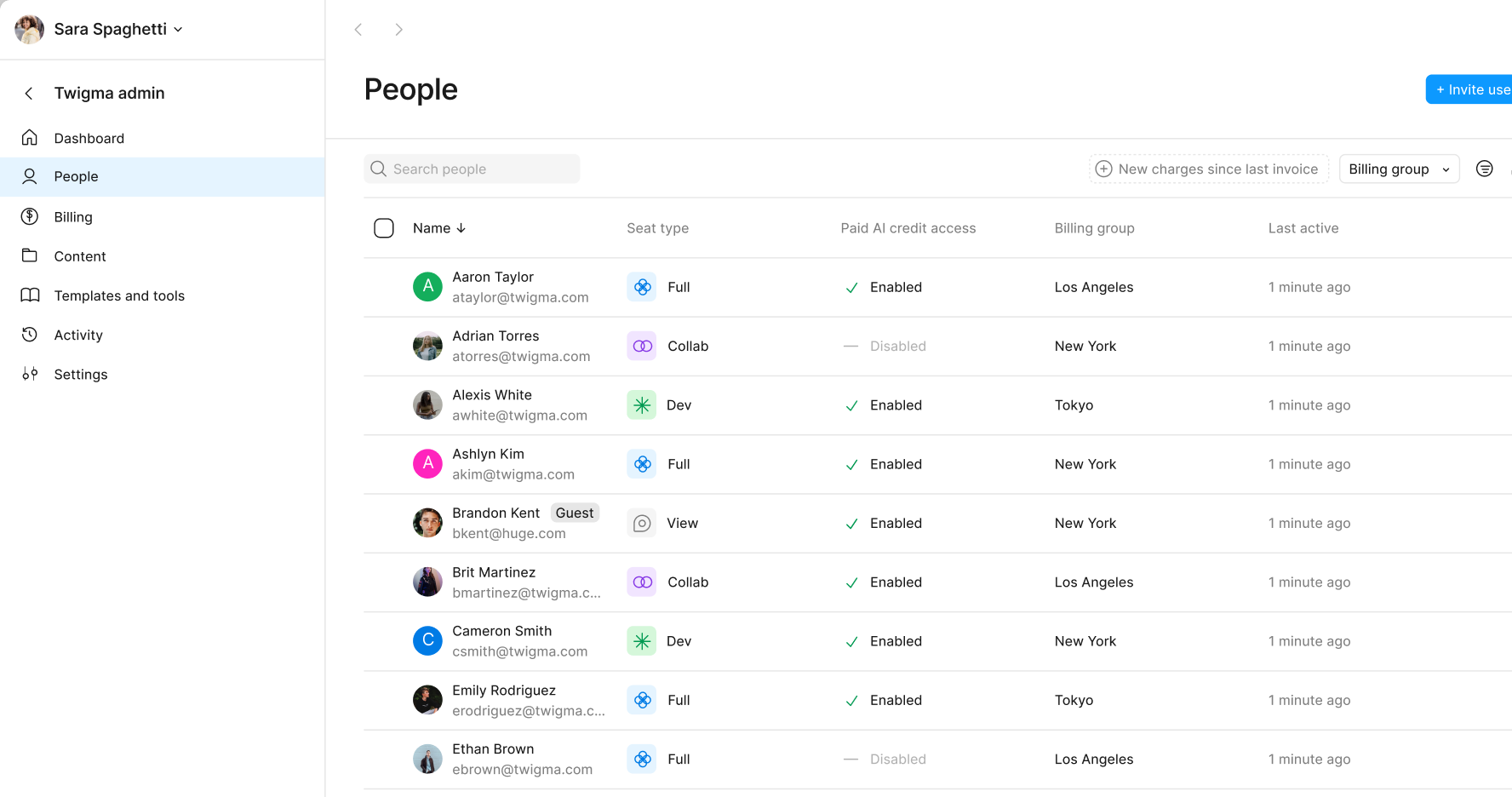
The product also had to spread before procurement did. New Professional editors could be added at any time, with no gates, until March 11, 2025, when Figma began requiring that “any seat upgrade needs to be approved by an administrator before the license is provisioned.”3,13
What to borrow
- Start outbound with the accounts already using you. Rank them on fit and usage before you buy a cold list, and track the share of pipeline that comes from them.
- Give reps the people along with the score. Let the rep choose who to contact and when.
- Use usage to open the conversation. A rep can say a team already uses you and ask what that means for the company. The case for a company-wide plan is still the rep’s to make.
How to build a version of this in Unify
Build it in Unify
From here on, the page describes our suggested version in Unify.
Figma spent years on the data underneath: a pipeline from its warehouse into Salesforce, users matched to companies, and analysts modeling usage. Unify combines your CRM, warehouse and product usage data with enrichment from 40+ sources. Product usage is synced in from your warehouse through a sync tool or the API, and lands as fields on accounts and people, as on this fictional account.
One account, from signal to next step
- Account
- Halden Health, a hospital group with 41 active users across three design teams on the self-serve plan, and no ownerIn the usage Audience: fits your closed-won profile, with usage synced from your warehouse.
- Signal
- Active users up from 26 to 41 since June, and visitors from the company read the Enterprise and security pages seven times this weekFrom product usage fields and website-visit Signals.
- Why it matters
- Halden is merging its patient app and clinician portal by spring, and each design team keeps its own componentsAI Research adds the news and hiring behind the usage to Nina’s task.
- Next step
- Nina Brooks, the new owner, approves a value-first email to Maya Lin, the most active user, then calls herFrom the Play: owner by territory, synced users added first, a Sequence the rep approves.
To start this week, sync active users and seats per company first. The two Audiences, the Play and the Sequence in the table below all read those fields.
outbound motion