


How Fin (Intercom) rebuilt reps’ trust in its outbound account list
Outbound teardowns by October 2026
- Company
- Fin sells customer service software built around Fin, its AI agent. It was called Intercom until May 2026, and Salesforce completed its acquisition of Fin in September 2026.1,2 Visit Fin ↗
- Who ran it
- Alexander DeMoulin, director of GTM Ops at Intercom
- This page
- The fall 2024 list rebuild; later Fin sources appear only in What it took
TL;DR
Reps worked only 19% of Intercom’s fourth outbound list. Ops then asked them which accounts they would actually work, turned the answers into rules, such as ranking companies with a login button on their website higher, and checked every account against Salesforce. Reps worked 72% of the next list in its first week.
The lesson
Messy CRM data broke the list. Duplicate records hid customers, owners and open deals, so reps couldn’t trust that any account was free to call. Intercom didn’t wait for a clean CRM; it checked every account against every record before a rep saw it.
For your team
Ask reps which accounts they would work, and check each one for CRM conflicts before you tune the score that ranks it.
What Intercom did
The starting point
Intercom bet the company on Fin, and outbound had to find new accounts.
In a May 2024 email to staff, reported by The Irish Times, CEO Eoghan McCabe wrote: “Winning in this game will require aggression on all fronts, not just with our capital.”3
Three years ago, our future was looking pretty bleak. I jumped back into the CEO role after a two year hiatus while sick, when we were heading quickly towards negative growth. …
We changed our targets to Fin revenue. … We moved our R&D focus to be nearly 80% on Fin, while that business was still a single digit percent of our revenue.
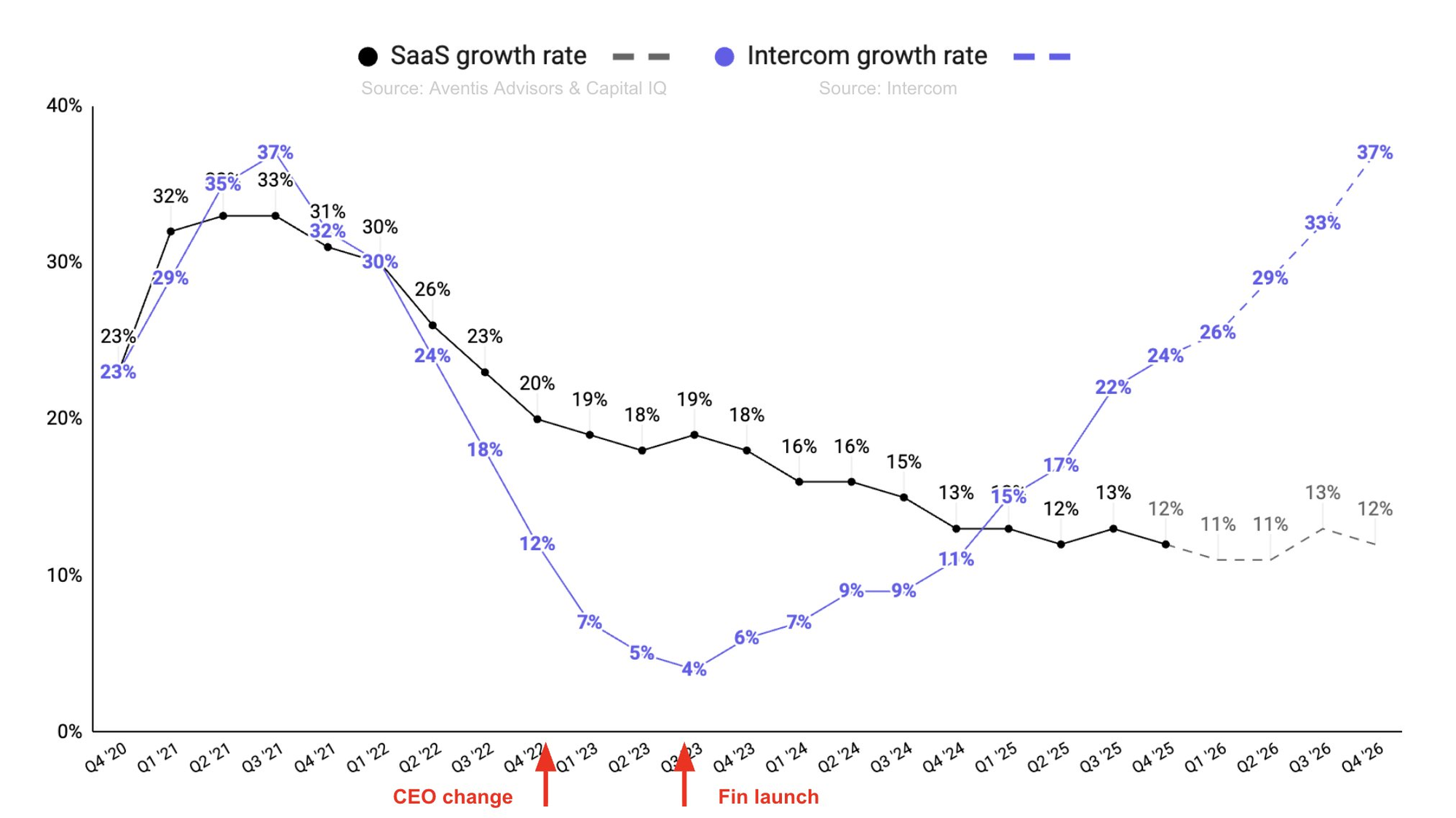
That fall, GTM Ops was launching outbound for the entire sales team, said Alexander DeMoulin, who ran it. Accounts that looked like Intercom’s existing customers had thinned out since 2022, he said, so reps would be calling companies unlike the ones they knew.5,6a
The problem
Sales worked 19% of the fourth list.
DeMoulin was at a chili cook-off in Sausalito one weekend in September 2024 when a Slack message arrived from his boss’s boss. It said the reps seemed to really dislike their new outbound list, and asked what had happened.5b His heart sank, he said, and he drove home to fix it.
It was the fourth list in his four years at Intercom.c The first used whatever data was in Salesforce, the second a cold list imported from outside, and the third good scoring and intent data mapped badly onto Intercom’s own records. Each time, he said, trust fell further.5
By his count, sales worked 19% of the fourth list’s accounts. It counted accounts reps were willing to send a single email.5 By then, sales would only give ops time for work that clearly helped them hit their number.6
In 2025 he said that on earlier lists he had doubted the accounts or the data sources, said nothing, and supported them anyway.6 In 2026 he said he had destroyed trust with the sales team three times in a row.7
The decision
September 2024
DeMoulin stopped perfecting the score and asked reps which accounts they would work.
Every account would be checked against Salesforce when it was assigned, because the CRM would never be clean.
Intercom was good at propensity modeling, DeMoulin said, but after so much lost trust the list had to match what reps thought a good account was. If they only wanted accounts that mention peanut butter on their website, he would find as many as he could.6
GTM Ops asked reps to describe the ideal outbound list as if they had a magic wand. It also sat behind reps on ride-alongs and asked what they look for in the 30 to 90 seconds they spend researching an account.5,6
DeMoulin did not believe Intercom would ever get rid of its duplicate Salesforce records, and would not let that stop the list. He said the trouble came when an account looked great on the list while a duplicate record was already in a relationship with Intercom, and the sales team was strictly monogamous.5
Ops promised reps that, while duplicates still existed, no assigned account would hide one.6
The redesign
Reps wrote the rules, in their own words.
Some rules took an account off the list; the rest ranked what was left.
“Don’t you dare assign me a customer”
Rules it out
Already a customer, owned by a relationship manager or in an open Salesforce deal
“We love our competitor’s customers”
Ranks it higher
Already paying a competitor
“You’re terminally online and we like that”
Ranks it higher
Has a login or “my account” button on its website, checked by an AI agent
The rules that took an account off the list were blunt: a country Intercom never sells to, or too few employees.5 A slide he showed at RevFest in June 2025 also flagged any company whose description mentioned “nonprofit”, “agency”, “consulting”, “acquired” or “now part of”.8
The ranking rules came from the ride-alongs. A login, sign-up or “my account” button on a company’s website meant a customer portal behind the marketing site, where customers raise support tickets.6 GTM Ops had an AI agent visit every account’s website to check, which DeMoulin called a vibe check that ordinary enrichment data could never give.5
Every record on the domain was checked
GTM Ops pooled accounts from Salesforce, data providers and intent sources, and collapsed them to one company per Clearbit domain.5 For each domain it queried every Salesforce account on it. His slides show the checks as columns, in his own labels: Customer?, RM Owned? (owned by a relationship manager), Sales Strategy?, Open Opps? and Recent Churn, and on the podcast he added activity in the last 60 days.5,6
An account that looked clean, with a duplicate record in a deal
Illustrative company and records; the checks are Intercom’s.
What the list showed
- Country
- United Kingdom
- Employees
- 1,200
- Customer?
- No records found
- Open Opps?
- No records found
Looks workable
What the check found
- Open Opps?
- 1 record found
Not assigned
Every Salesforce record on the domain was checked, column by column: Customer?, RM Owned?, Sales Strategy?, Open Opps?, Recent Churn, plus activity in the last 60 days. Any record found kept the account off the list.
Reps still searched Salesforce for duplicates themselves, which DeMoulin said was right, before reaching out.6
The result
Sales worked 72% of the new list in week one.
The rebuilt list went out less than a week later.
Lists 1 to 3: Salesforce data, a cold import, scoring and intent data
List 4, fall 2024
19%
Number of accounts worked by Sales
List 5, first week
72%
Number of assigned accounts worked by Sales
No salesperson had ever told him a list was really good and that they couldn’t wait to cold outbound to it, he said, until this one.6
With bad data no longer the excuse, ops could see reps spending too long on low-propensity inbound deals, cold email copy that wasn’t landing, and buyer personas that no longer fit an AI buying committee.5 When accounts sales had picked sat untouched, ops asked why, and sometimes a rep simply had too many inbound deals.6
What it took
A weekend of ops work started it, and keeping it right became an engineering job.
The loop DeMoulin’s team ran on the list
- PrototypeA weekend in September 2024
- FeedbackReps worked 72% and told ops what failed
- IterateBatches went monthly, then quarterly, then twice a year
- OperationalizeA systems team by Sep 2025; his team’s first GTM engineer, Sep 10, 2025; a staff data engineer role, Aug 2026
The first rebuild ran on GTM Ops time and data Intercom already had. Batches went from monthly to quarterly, and by September 2025 to twice a year, as a systems team took over the website enrichment ops had prototyped.5,6
On September 10, 2025, DeMoulin posted that he was hiring the first GTM engineer onto his team in San Francisco, to improve GTM processes with AI.9
In August 2026 Fin posted a Staff Data Engineer, GTM role in its Data group. It owns account identity, hierarchy, deduplication, sourcing, enrichment and data-quality monitoring, the same problems the weekend rebuild worked around.10
What to borrow
- Track how much of the list reps actually work. Check it before meetings or pipeline. Intercom went from reps working 19% of the accounts to 72%.
- Ask your reps what makes an account worth calling, and turn the answers into rules. Intercom asked reps to describe their dream list and sat with them while they researched accounts. That’s how it learned a login button on a company’s website was a good sign.
- Check the CRM before a rep gets an account. Rule out anything already a customer, owned by someone else or in an open deal. Intercom’s CRM was never fully clean, so it ran this check on every account, every time.
How to build a version of this in Unify
Build it in Unify
Everything above is what Intercom did. From here on, this is our suggestion for a version in Unify.
Intercom’s GTM Ops joined its data itself: Salesforce, data providers, intent sources and a website scrape. Unify combines your CRM, warehouse and product usage data with enrichment from 40+ sources, with warehouse data synced in through a sync tool or the API. A rep working the list would see an account like this fictional one.
One account, from signal to next step
- Account
- Tidewell Pay, a payments app in Dublin with 900 employeesIn the workable Audience: right country and size, and no CRM record on its domain is a customer, owned, in a deal, recently churned or recently worked.
- Signal
- A customer login on every page, a 30-day free trial, and two support roles posted in SeptemberFrom AI Agent qualification questions written from the reps’ checks.
- Why it matters
- Its customers log in to accounts, so they raise support tickets, and the team answering them is growingAI Research on the rep’s task says why it qualifies and why it is safe to call.
- Next step
- Maya Collins in Dublin confirms there is no duplicate in the CRM, then approves an email to Nora Quinn, Head of SupportFrom the Play: owner assigned by territory, three support leaders found, and a Sequence the rep approves.
This week, run the session with reps and list the CRM fields that make an account unworkable. The Audience, the AI Agent qualification questions and the Play are built from that session.
did this